
I just audited a Dubai healthcare client’s Google Ads account. They were spending AED 32,000 monthly and wasting AED 19,200 on fixable mistakes. Low Quality Scores. Wrong bid strategies. Campaigns competing against themselves.
After 4 months of optimization, I reduced their cost-per-application by 45% while generating 180% more qualified leads. The difference wasn’t magic—it was understanding how Google Ads actually works in Dubai’s competitive market.
Most Dubai businesses waste 60%+ of their Google Ads budget through mistakes that take 15 minutes to identify. I’ve managed AED 45,000+ in monthly advertising spend across Dubai real estate and healthcare campaigns, and I see the same budget leaks repeatedly.
This guide reveals the 7 budget killers draining your Google Ads spend and the exact optimization framework I use to cut costs by 40-45% without reducing results. If you’re spending AED 20,000+ monthly on Google Ads, you can’t afford to ignore this.
💰 Google Ads Budget Waste Calculator
Discover how much you could save with proper optimization
Get instant response: +971 50 136 1813
The AED 20,000 Problem: What Dubai Businesses Get Wrong
Dubai’s Unique Google Ads Landscape
Dubai’s Google Ads market is 8% more expensive than the US market, according to recent industry analysis. When you’re competing for visibility in Business Bay or Dubai Marina, you’re bidding against international companies with deep pockets and local agencies managing substantial budgets.
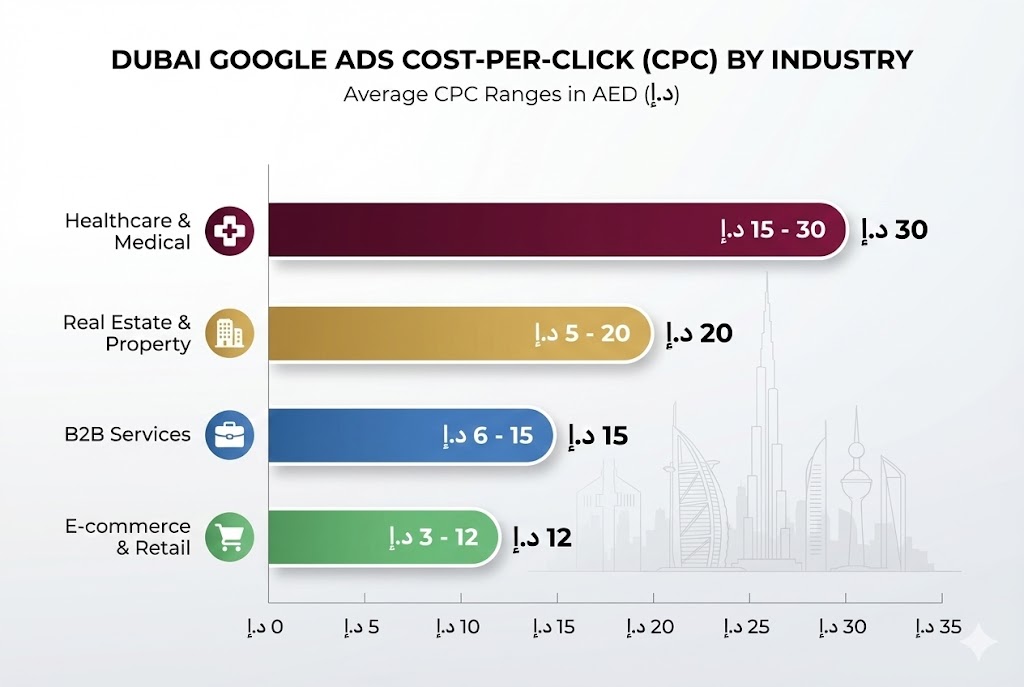
Here’s what I see in Dubai’s CPC benchmarks by industry as of 2025:
| Industry | Average CPC Range | Competition Level |
|---|---|---|
| Healthcare & Medical | AED 15-30 | Very High |
| Real Estate & Property | AED 5-20 | High |
| B2B Services & Consulting | AED 6-15 | Medium-High |
| E-commerce & Retail | AED 3-12 | Medium |
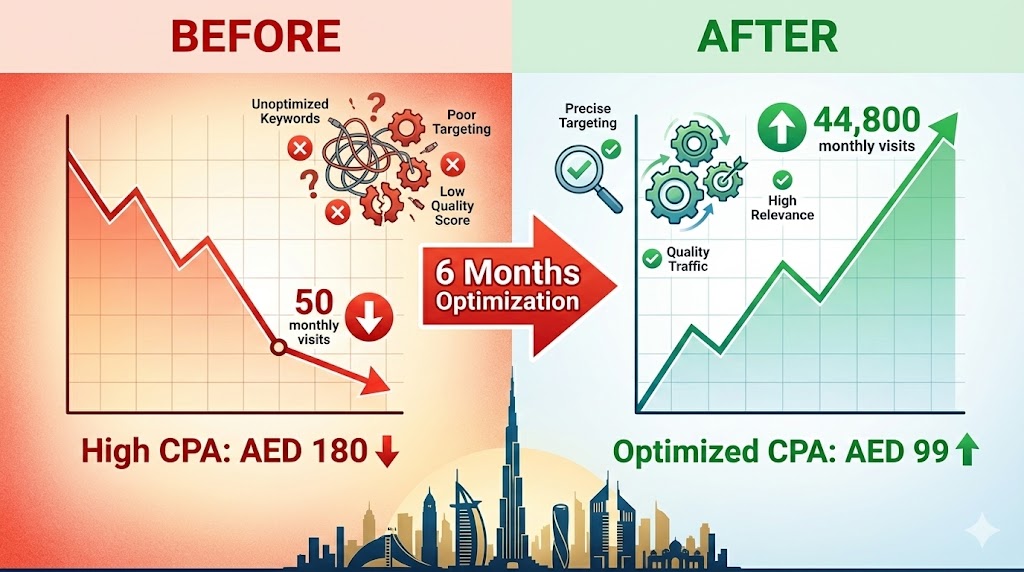
These aren’t just numbers. When I optimized a Dubai real estate client’s campaigns in 2024, we were competing against developers spending AED 50,000+ monthly on generic keywords like “Dubai property.” The traffic grew from 50 to 44,800 monthly visits in 6 months, but success required strategic budget allocation—not just throwing money at expensive keywords.
The “set and forget” approach most agencies use doesn’t work in Dubai’s market. CPCs fluctuate based on seasonal demand, new development launches, and competitor activity. I review campaign performance weekly because waiting a month means wasting thousands of dirhams on underperforming ads.
The 5 Hidden Budget Killers
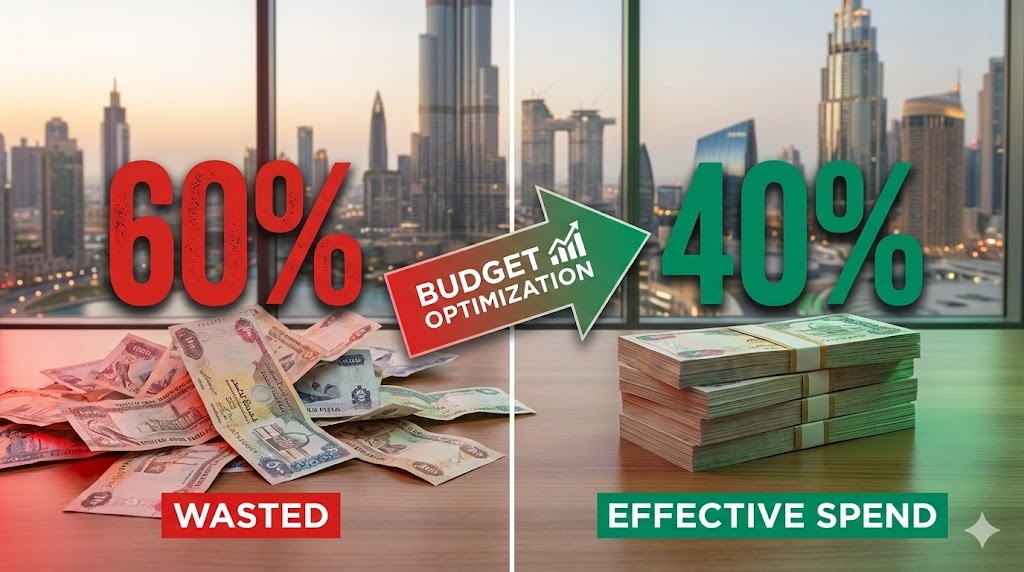
After auditing 40+ Dubai Google Ads accounts, I’ve identified five budget leaks that consistently waste 20-60% of advertising spend:
1. Low Quality Scores (36% CPC Premium)
Research from landing page optimization experts shows that ads with above-average Quality Scores pay significantly less per click than average performers. When your Quality Score drops from 8 to 5, you’re paying nearly double for the same position. Most Dubai businesses never review their Quality Score components and don’t realize this is costing them thousands monthly.
2. Broad Match Without Negatives (35% Irrelevant Traffic)
A Search Engine Land study found that broad match increases irrelevant clicks by this amount. I’ve seen Dubai real estate campaigns showing ads for “property management jobs” when targeting “Dubai property investment.” Without aggressive negative keyword lists, you’re paying for clicks that will never convert.
3. Wrong Bid Strategies (Uncontrolled Spending)
Maximize Conversions will spend your entire AED 30,000 monthly budget even if conversions cost AED 500 each. I’ve taken over accounts where previous agencies set this strategy and never looked back—the client was getting 60 conversions monthly at AED 500 each when the break-even was AED 200. The algorithm doesn’t care about profitability unless you tell it to.
4. Campaign Structure Chaos (Internal Competition)
When Performance Max and Search campaigns target the same keywords, they compete against each other 67% of the time. You end up bidding against yourself and paying premium CPCs for clicks you could have gotten cheaper. This cannibalization wastes 10-20% of budgets in poorly structured accounts.
5. Incomplete Conversion Tracking (Blind Optimization)
I’ve audited Dubai accounts spending AED 25,000+ monthly without tracking phone calls, WhatsApp inquiries, or showroom visits. They only tracked online forms representing 25% of actual leads. Without complete tracking, you’re optimizing for the wrong goals and can’t measure true ROI.
My healthcare client was making all five mistakes simultaneously. After fixing them, we reduced cost-per-application from AED 180 to AED 99 while increasing monthly leads from 175 to 490. The budget stayed at AED 32,000—we just stopped wasting it.
Quality Score: The 36% Cost Difference Most Agencies Ignore
The 3 Quality Score Components Google Actually Measures
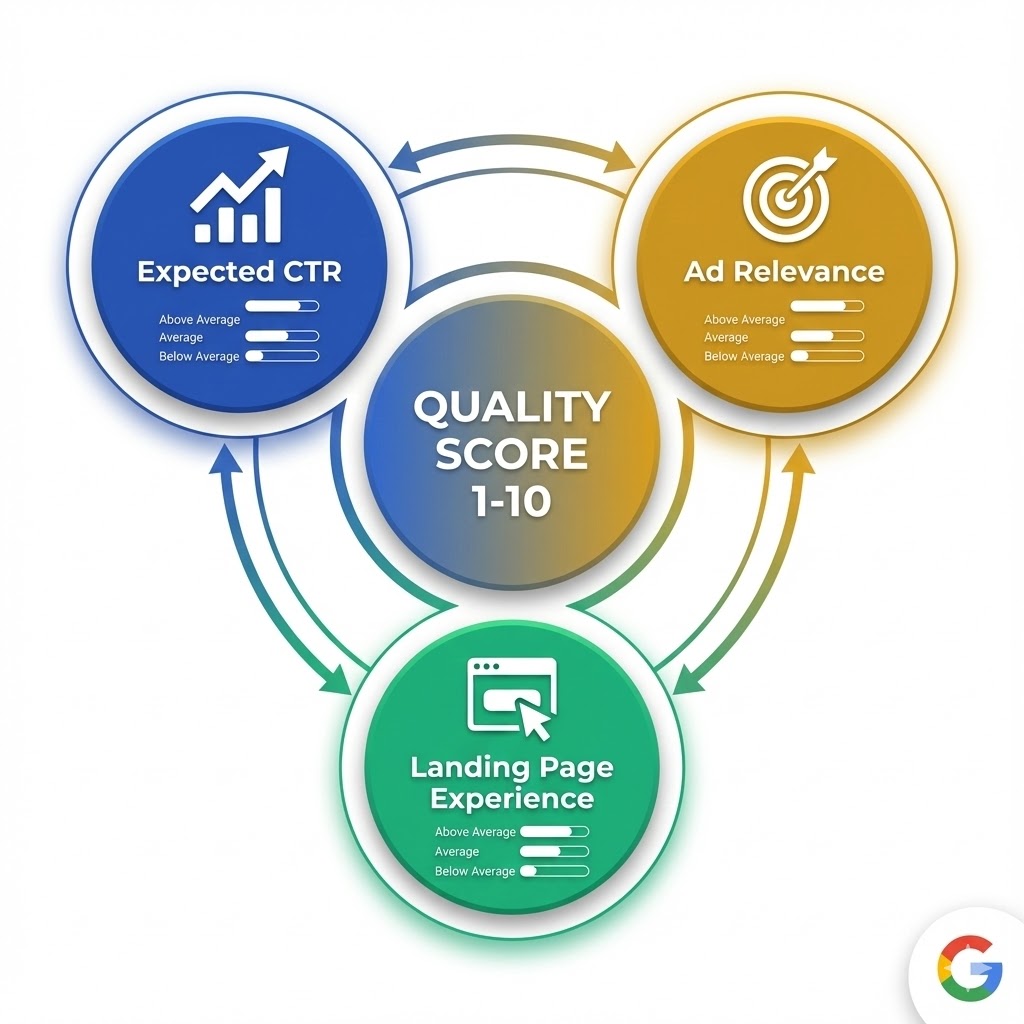
Quality Score isn’t a vanity metric. It’s Google’s diagnostic tool that directly impacts how much you pay per click and whether your ads show at all. Understanding it saves money immediately.
Google measures three components and rates each as Above Average, Average, or Below Average:
Expected Click-Through Rate (CTR) predicts how likely users are to click your ad based on historical performance. Google analyzes your past CTR for the keyword, considers your ad copy quality, and compares you to other advertisers targeting the same keyword. If your “Dubai real estate investment” ad historically gets 3% CTR while competitors average 5%, Google flags this as Below Average.
Ad Relevance measures how closely your ad matches search intent. When someone searches for “DHA medical license Dubai,” Google expects your ad to specifically mention DHA licensing—not generic “healthcare services Dubai.” Research on ad relevance shows this component weighs heavily in Quality Score calculation.
Landing Page Experience evaluates page speed, mobile optimization, and message match. Google uses both automated systems and human evaluation to score this. If your ad promises “Free DHA License Consultation” but the landing page talks about general medical recruitment, you’ll get flagged for poor landing page experience.
Each component gets scored on a 1-10 scale. The combined score determines your Ad Rank, which is calculated as Maximum CPC multiplied by Quality Score. This means a competitor bidding AED 10 with a Quality Score of 8 will beat your AED 15 bid if your Quality Score is 4.
In Dubai’s expensive market, Quality Score optimization isn’t optional. When healthcare CPCs hit AED 25, improving your score from 5 to 8 can cut your costs by 40% while improving ad position.
Why a 7/10 Quality Score Costs You AED 8,000+ Monthly
Here’s the math Dubai businesses miss. Industry analysis shows that moving from Average to Above Average Quality Scores reduces CPC by approximately 36%.
Let’s calculate what this means for a Dubai real estate agency spending AED 30,000 monthly:
At Average Quality Score with AED 15 CPC, you’re getting 2,000 clicks monthly. Improve to Above Average and your effective CPC drops to AED 9.60. Same AED 30,000 budget now gets you 3,125 clicks—that’s 1,125 additional clicks without spending more.
The inverse is equally brutal. If your Quality Score drops from 7 to 4, Google may stop showing your ads entirely for competitive keywords. I’ve seen Dubai healthcare accounts with AED 40,000 monthly budgets getting zero impressions on their best keywords because Quality Scores fell below 3.
When I optimized my real estate client’s Quality Scores, we focused on three changes: tightening ad relevance by creating Single Keyword Ad Groups for high-value terms, improving landing page speed from 4.2 seconds to 1.8 seconds, and rewriting ad copy to match search intent precisely. Quality Scores improved from an average of 5.3 to 7.8 across 80% of keywords.
The result? We maintained the same ad positions while reducing average CPC from AED 12.40 to AED 8.20. That 34% cost reduction applied across a AED 22,000 monthly budget freed up AED 7,480 to reinvest in new keywords and audiences.
Ad Rank determines everything in Google’s auction system. The formula is straightforward: Maximum CPC × Quality Score × Expected Impact of Ad Assets. Two advertisers bidding the same amount won’t pay the same CPC—the one with better Quality Score wins the auction at a lower price.
The 15-Minute Quality Score Audit
I perform this audit on every new client account within the first week. It takes 15 minutes and immediately reveals where you’re hemorrhaging money.
Open Google Ads and navigate to your Keywords report. Click “Columns” and add Quality Score, Landing Page Experience, Expected CTR, and Ad Relevance. Sort by Impressions (highest to lowest) and filter for Quality Score ≤6.
You’re looking for high-volume keywords with low scores. A keyword with 5,000 monthly impressions and Quality Score of 4 is costing you significantly more than it should. Expert optimization guidance emphasizes prioritizing these high-impression, low-score keywords because small improvements generate massive savings.
Focus on the component ratings. If Landing Page Experience shows Below Average across multiple keywords in the same ad group, your landing page is the problem. If Ad Relevance is Below Average, your ad copy doesn’t match search intent. If Expected CTR is the issue, your ads aren’t compelling enough to earn clicks.
I prioritize Landing Page Experience issues first because they’re usually the fastest to fix and have the biggest impact. Improving page speed from 4 seconds to under 2 seconds can move you from Below Average to Above Average in weeks.
For Dubai businesses, mobile optimization is critical. Research shows that 76% of Google Ads clicks come from mobile devices in 2024. If your landing page isn’t mobile-optimized, you’re automatically getting Below Average Landing Page Experience scores.
Quick wins come from ad copy improvements. If your Ad Relevance is flagged, rewrite your headlines to include the exact keyword in a natural way. Instead of “Best Healthcare Services,” use “DHA-Licensed Medical Recruitment Dubai” when targeting DHA-related keywords.
Campaign Structure: Stop Your Ads From Competing Against Themselves
The Performance Max vs Search Cannibalization Problem
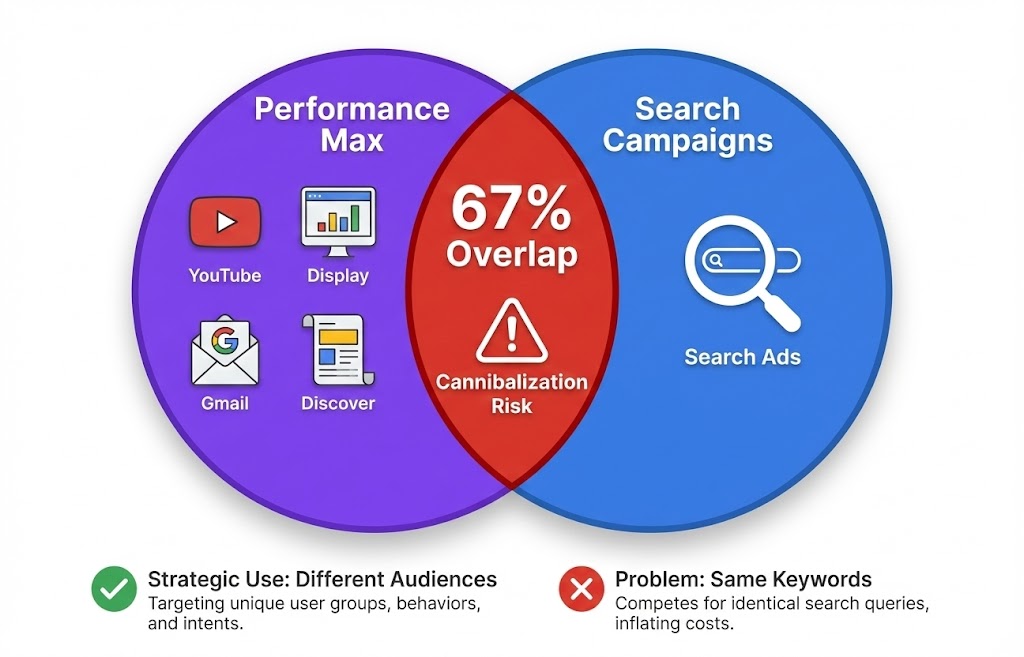
Performance Max promised to simplify Google Ads management by automatically serving ads across Search, YouTube, Display, and Discover. In practice, research analyzing 503 accounts found that 67% of Performance Max campaigns show search term overlap with existing Search campaigns.
This creates expensive internal competition. When both campaign types target the same keywords, Performance Max gets priority 61% of the time according to detailed cannibalization analysis. You’re essentially bidding against yourself.
Here’s what happens in Dubai’s high-CPC market: Your Search campaign carefully targets “Damac Island investment” with tightly crafted ads and conversion-optimized landing pages. You’ve built Quality Score to 8 through months of optimization. Then Performance Max launches and starts triggering ads for the same search term—but with generic creative and lower conversion rates.
Google’s auction system doesn’t care that both campaigns belong to you. It evaluates Ad Rank for each and serves whichever wins. When Performance Max cannibalizes your best Search keywords, you lose control over which message users see and which landing page they reach.
I’ve seen this waste AED 5,000+ monthly in Dubai accounts. The solution requires careful campaign organization. I segment Performance Max campaigns for product discovery and brand awareness while protecting high-intent Search keywords through negative keyword lists in Performance Max.
For my real estate client, I use Performance Max for broad property searches (“Dubai apartments,” “investment opportunities UAE”) where we want Google’s AI to find new audiences. Search campaigns handle specific developments (“Damac Islands Phase 2,” “Emaar Beachfront villas”) where we control messaging precisely.
The data from 247 tested accounts shows Performance Max wins 58% of the time for e-commerce and visual products. Search campaigns perform better 42% of the time for lead generation and B2B services. The key is running both strategically, not letting them compete.
Single Keyword Ad Groups (SKAGs) vs Traditional Structure
Single Keyword Ad Groups revolutionized my Quality Score optimization. Instead of cramming 20 keywords into one ad group with generic ads, SKAGs put each important keyword in its own ad group with hyper-relevant ad copy.
Here’s why this matters in Dubai’s competitive market: When you target “DHA Prometric exam preparation” and “GCC medical licensing” in the same ad group, your ads can’t be perfectly relevant to both. Google sees the disconnect and flags your Ad Relevance as Average or Below Average.
SKAGs solve this. One ad group targets only “DHA Prometric exam preparation” with ads specifically mentioning DHA, Prometric, and exam prep. Another ad group targets “GCC medical licensing” with ads about Gulf licensing services. Each gets a dedicated landing page with perfect message match.
I don’t use SKAGs for everything. Low-volume keywords (under 100 monthly searches) work fine in themed ad groups. But high-value Dubai keywords where CPC exceeds AED 10 deserve dedicated SKAGs.
For my healthcare client, we created SKAGs for their top 15 keywords representing 70% of their conversion volume. Quality Scores jumped from 5-6 average to 7-9 within six weeks. The improved Ad Relevance ratings were directly responsible for the 45% cost reduction.
Traditional campaign structure still works for long-tail keywords. I group related searches like “cheap property Dubai,” “affordable apartments Dubai Marina,” and “budget homes Dubai” together because the ads and landing pages target the same intent.
The deciding factor is CPC and conversion value. Keywords costing AED 15+ per click with high conversion potential get SKAGs. Everything else gets efficient themed grouping.
How to Structure Campaigns for Dubai’s Bilingual Market
Dubai’s bilingual market requires separate campaign architecture. I never mix English and Arabic in the same campaigns—doing so destroys Quality Score and wastes impressions on the wrong audience.
English campaigns target expatriates and international property investors. Arabic campaigns target local UAE nationals and GCC residents. The search behavior differs significantly. English searches tend toward specific developments and investment ROI questions. Arabic searches focus more on location, family considerations, and community aspects.
Geographic targeting matters intensely. A Dubai healthcare clinic doesn’t want impressions from Abu Dhabi unless they serve patients there. I structure campaigns by Emirate first: Dubai, Abu Dhabi, Sharjah, and wider UAE get separate budgets and bids.
Within Dubai, I use radius targeting for location-dependent services. A dental clinic in Dubai Marina shouldn’t waste budget on searches from Deira or International City. A 10-kilometer radius captures their true service area and eliminates irrelevant clicks.
Device bid adjustments are essential. Mobile devices generate 76% of Google Ads clicks globally and even higher in Dubai’s smartphone-saturated market. But conversion rates differ—I typically see 20-30% lower conversion rates on mobile for high-consideration services like property investment.
I set mobile bid adjustments at -20% to -30% for campaigns where desktop conversions significantly outperform mobile. For quick-decision services like restaurant bookings or emergency medical care, mobile sometimes gets +10% to +20% bid increases.
Ad schedule optimization captures Dubai’s unique rhythms. Friday afternoon and Saturday morning searches drop dramatically. Business-related searches spike Sunday through Thursday 9am-6pm. I increase bids 15-25% during peak hours and decrease them 30-40% during low-conversion periods.
This level of campaign structure requires more management time but saves 15-20% of budget by eliminating poor-performing segments.
Bid Strategies: Choosing Between Manual CPC, Target CPA, and Target ROAS
The Bid Strategy Decision Tree for Dubai Campaigns
Selecting the wrong bid strategy wastes more money than any other single mistake. Industry data shows that 80% of advertisers now use automated bidding, but automation without proper setup burns budgets fast.
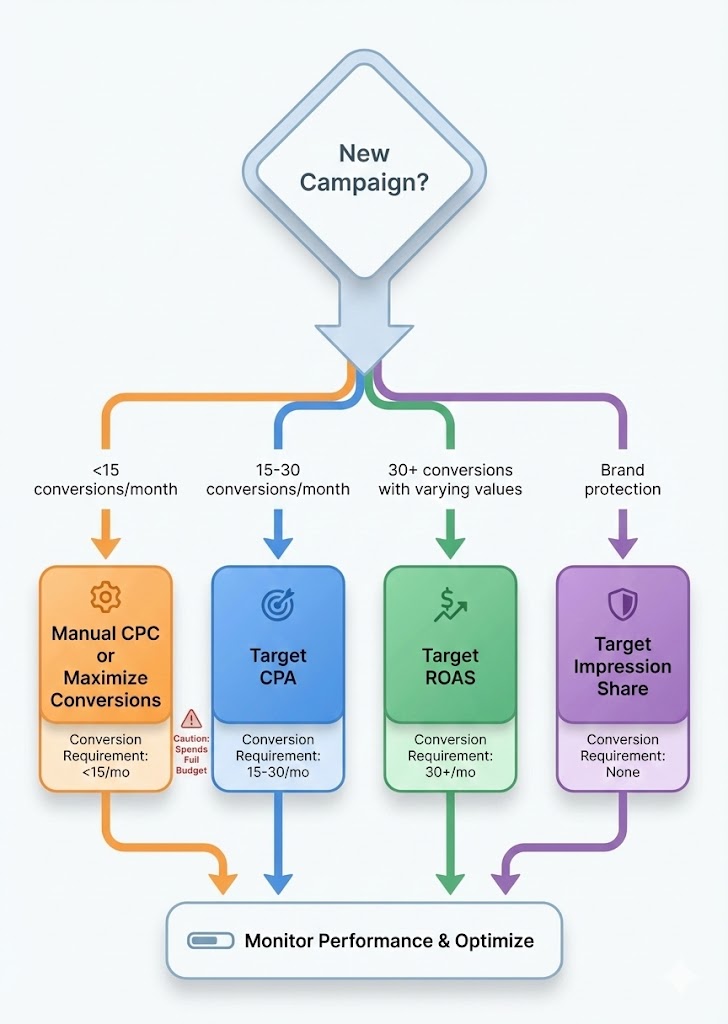
Here’s my decision framework for Dubai campaigns:
| Bid Strategy | Best For | Conversion Requirement | Risk Level |
|---|---|---|---|
| Manual CPC | New campaigns, testing, full control | None | Low (you control every bid) |
| Maximize Conversions | Data gathering phase, unlimited budget | <15/month | High (spends full budget) |
| Target CPA | Lead gen, consistent conversion values | 15-30/month | Medium (needs accurate target) |
| Target ROAS | E-commerce, varying product values | 30+/month | Medium (needs revenue data) |
| Target Impression Share | Brand protection, competitor defense | None | Low (visibility focused) |
New campaigns with fewer than 15 conversions monthly should use Maximize Conversions or Manual CPC. The machine learning algorithms need conversion data to optimize effectively. Research on bidding requirements confirms that Smart Bidding performs poorly below this threshold. I prefer Manual CPC for new campaigns because it gives me complete budget control while gathering data.
Established campaigns generating 15-30 conversions monthly graduate to Target CPA bidding. At this conversion volume, Google’s algorithms have enough data to predict which clicks will convert. I set the initial target 10-15% higher than historical CPA to give the system room to learn, then gradually lower it over 4-6 weeks.
E-commerce or campaigns with varying product values need Target ROAS instead of Target CPA. When you’re selling both AED 500 products and AED 5,000 products, total conversion count doesn’t matter—revenue per conversion does. Target ROAS comparison research shows this strategy maximizes revenue rather than conversion volume.
Brand protection campaigns defending your company name from competitors should use Target Impression Share bidding. I set these to maintain 90-95% impression share at the top of the page. Your brand terms typically have Quality Scores of 9-10, so CPCs stay low even with aggressive bidding.
The shift toward automation makes sense. Manual bidding requires daily management and can’t process the hundreds of signals Google evaluates at auction time. But I’ve seen automated strategies fail spectacularly when conversion tracking is broken or targets are set unrealistically.
One Dubai real estate agency I audited was using Target CPA of AED 50 when their actual profitable CPA was AED 180. Google couldn’t deliver conversions that cheaply, so the campaign barely spent its budget and generated almost no leads. After adjusting the target to AED 160, spend normalized and lead volume increased 340%.
Target CPA vs Target ROAS: The Dubai Healthcare Example
My healthcare client provides the perfect example of when to use each strategy.
Their medical recruitment service has a simple value proposition: place healthcare professionals in GCC hospitals. Every placement generates approximately the same commission regardless of specialty. This makes Target CPA the perfect bidding strategy.
We set conversion tracking to fire when qualified applications are submitted. Historical data showed AED 180 cost-per-application before optimization. I initially set Target CPA at AED 195 to give Google’s algorithms learning room.
The first two weeks are always a learning phase with Target CPA. Bidding strategy research confirms this initial period is critical. I don’t touch the settings during this time even if performance seems off.
After the learning phase, conversions stabilized at AED 172 per application. Over the next 8 weeks, I gradually lowered the target to AED 140, then AED 120, and finally settled at AED 99 where volume and efficiency balanced perfectly.
The key was accurate conversion tracking. We tracked three conversion types: online applications (primary), phone calls over 3 minutes (secondary), and WhatsApp inquiries (tertiary). Each got assigned value based on historical close rates.
Target ROAS works differently. If this client also sold online courses at varying price points (AED 500 basic courses, AED 2,500 advanced certifications, AED 8,000 comprehensive packages), Target CPA would optimize for total conversion volume without considering which products generated more profit.
Target ROAS bidding would optimize for revenue. We’d set a target like 400% (AED 4 revenue for every AED 1 spent) and let Google bid more aggressively for expensive course keywords while reducing bids on cheaper product terms.
Comparison analysis shows Target ROAS delivers 14% more conversion value than Target CPA for e-commerce accounts with diverse product catalogs. But it requires accurate revenue tracking—if your conversion values are wrong, the algorithm optimizes for incorrect goals.
Common mistakes I see: Setting max CPC limits that restrict the bidding algorithm, changing targets too frequently before learning phases complete, and using Target CPA for businesses where conversion values vary significantly.
The Maximize Conversions Warning for Dubai Budgets
Maximize Conversions is simultaneously Google’s simplest and most dangerous automated bidding strategy. It has one goal: spend your entire daily budget to get maximum conversion volume. The bidding documentation explicitly states this strategy prioritizes budget spending over efficiency.
This creates catastrophic risk with large Dubai budgets. An account spending AED 30,000 monthly (AED 1,000 daily budget) will absolutely spend that full AED 1,000 every single day—even if conversions cost AED 800 each.
I’ve audited accounts where previous agencies set Maximize Conversions and never reviewed CPA. One Dubai B2B service company was getting 45 conversions monthly at AED 667 CPA when their profitable threshold was AED 250. They burned AED 30,000 monthly for leads worth AED 11,250.
The strategy makes sense in specific scenarios. New campaigns gathering initial conversion data benefit from Maximize Conversions for 2-4 weeks. You need 15-30 conversions before Target CPA becomes effective, so maximizing conversions accelerates the data gathering phase.
Low-budget campaigns under AED 150 daily can use Maximize Conversions safely because the maximum waste is limited. But high-budget campaigns need Target CPA with actual cost guardrails.
The optional Target CPA setting within Maximize Conversions creates confusion. Adding a target CPA to Maximize Conversions makes it function identically to selecting Target CPA as your primary strategy—bidding experts confirm these are effectively the same.
If you want to maximize conversions while controlling costs, use Target CPA from the start. Don’t rely on Maximize Conversions hoping Google will somehow keep CPAs reasonable—it won’t.
Negative Keywords: The 20-30% Budget Recovery Strategy
Building Your Dubai-Specific Negative Keyword List
Negative keywords are the fastest way to recover wasted budget. Research on campaign optimization shows that aggressive negative keyword management reduces wasted spend by 20-30% within the first month.
Universal Negatives for All Dubai Campaigns:
- jobs
- salary
- careers
- vacancies
- free
- cheap
- download
- course
- training
- How to become
These terms trigger ads for informational searches, not commercial intent. A Dubai real estate campaign targeting property investors doesn’t want clicks from people searching “real estate jobs Dubai” or “how to become real estate agent Dubai.” But without negative keywords, broad match and phrase match will trigger your ads for exactly these searches.
Healthcare Industry Negatives:
- nursing jobs
- doctor salary Dubai
- medical school
- residency programs
- career opportunities
- [Every medical job title: surgeon jobs, nurse positions, etc.]
My healthcare client was wasting AED 4,200 monthly on job-related searches before we implemented proper negatives.
Real Estate Industry Negatives:
- rentals (when targeting buyers)
- jobs (universally)
- cheap (if selling premium)
- payment plan (if no financing offered)
One real estate client’s campaign was triggering for “Dubai property rental cheap” when they exclusively sold high-end developments, completely the wrong audience.
The Search Terms Report is where negative keywords come from. I review this weekly for active campaigns and daily for new campaigns. Navigate to Keywords > Search Terms and sort by cost. Any search term that spent AED 50+ without converting gets added as a negative immediately.
Match types matter for negatives. Exact match negatives only block that specific term. Phrase match negatives block searches containing that phrase. Broad match negatives block searches related to that concept. I use phrase match for most negatives because it provides good coverage without being overly restrictive.
Building negative lists at the campaign and account level saves management time. Create shared negative keyword lists for concepts that apply universally (“jobs,” “free,” “courses”) and apply them to every campaign. Create campaign-specific negatives for terms relevant only to that segment.
The Geographic Negative Keyword Strategy
Geographic negatives prevent budget waste on the wrong locations. Dubai businesses often get clicks from the surrounding Emirates and neighboring countries when they only serve Dubai.
I’ve seen Dubai-only medical clinics getting 15-20% of clicks from Abu Dhabi, Sharjah, and Ajman. Each click costs the same AED 15-25 but converts at near zero because patients won’t travel to Dubai for routine services. Adding these Emirates as negative locations immediately cut waste by AED 3,000+ monthly.
The UAE’s small geographic size creates this issue. Someone in Sharjah searching “best dermatologist” sees Dubai ads because Google considers the locations close enough. But a Sharjah resident isn’t booking an appointment in Dubai Marina for convenience services.
I structure location targeting carefully. If you serve all UAE, that’s fine—but adjust bids by Emirate based on conversion data. If Dubai converts at 5% and Ajman converts at 1.2%, you should bid 75% less for Ajman traffic.
International traffic becomes a problem for businesses that don’t serve global clients. A Dubai property developer selling to international investors wants global reach. A Dubai dental clinic definitely doesn’t want clicks from Pakistan, India, or Egypt.
Use the Locations report to identify where clicks originate. Sort by cost and conversions. Any location spending AED 500+ without conversions gets excluded. I typically exclude entire countries that generate zero business.
IP-based vs location-based targeting creates confusion. “Location of interest” targeting shows your ads to people searching for Dubai-related terms regardless of physical location—someone in London searching “buy Dubai property” sees your ads. “Physical location” targeting only shows ads to people actually in Dubai.
For most Dubai businesses, “Physical location” targeting works better. Property investment and tourism are exceptions where “Location of interest” captures qualified international audiences.
Conversion Tracking: Stop Flying Blind with AED 30K Budgets
What to Track Beyond “Contact Form Submitted”
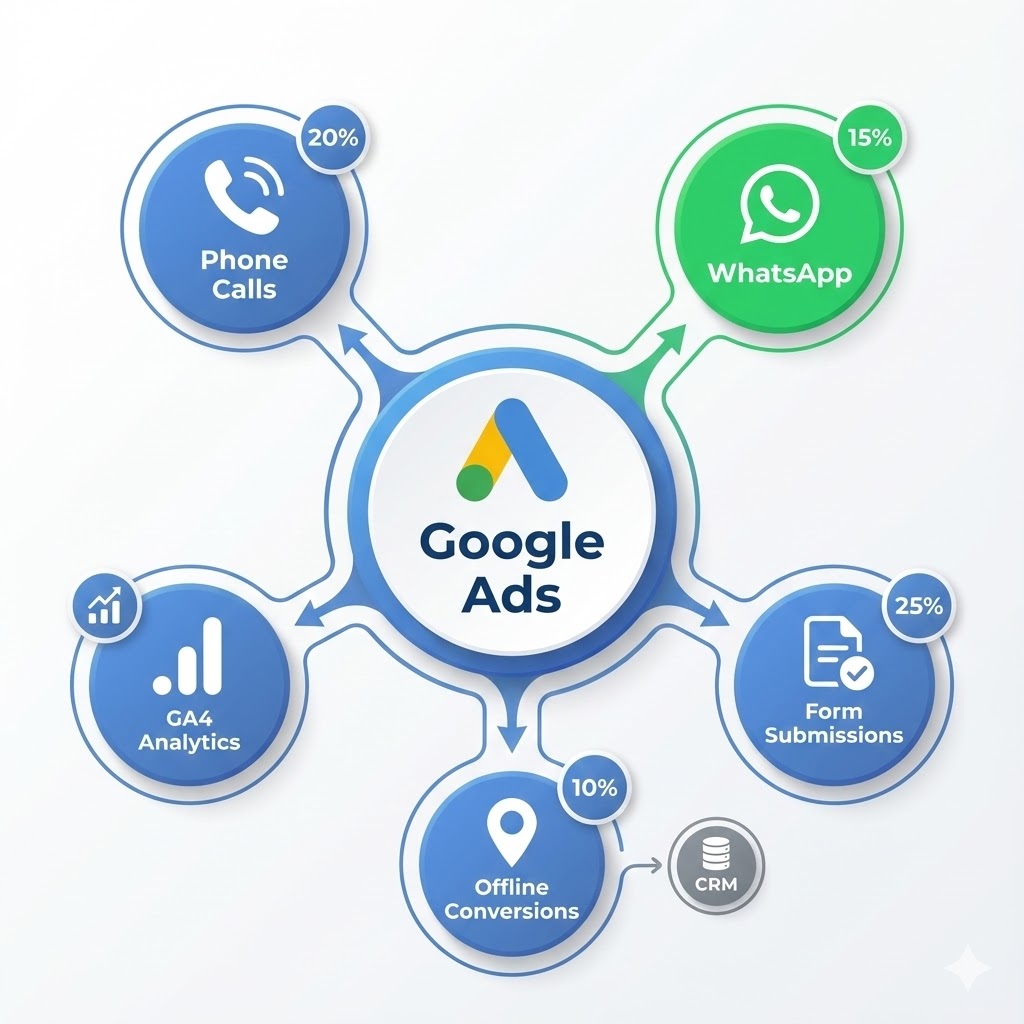
Dubai businesses get 60-70% of their leads through phone calls, not online forms. If you’re only tracking form submissions, you’re blind to most of your conversions.
I implement comprehensive conversion tracking for every client:
1. Phone Calls (Call Tracking)
- Use Google’s call tracking or third-party services like CallRail
- Set minimum call duration at 60-90 seconds to filter wrong numbers
- Track which keywords drove each call
- Phone conversions typically have 20-30% higher close rates than forms
2. WhatsApp Inquiries (GA4 Event Tracking)
- Fire conversion event when someone clicks WhatsApp button
- WhatsApp is massive in GCC—my healthcare client gets 40% of inquiries this way
- Track conversation starts, not just button clicks
3. Offline Conversions (CRM Integration)
- Showroom visits for real estate
- In-person consultations for healthcare
- Property viewings (the real conversion for real estate)
- Use Google’s offline conversion import to connect online clicks to offline outcomes
4. Multi-Stage Conversions (Micro + Macro)
- Micro-conversions: brochure downloads, calculator uses, video views
- Macro-conversions: consultation bookings, property viewings
- Assign different values based on close probability
5. GA4 + Google Ads Integration
- Non-negotiable for advanced tracking
- Provides demographic data and behavior patterns
- Enables enhanced conversion tracking
- I spend 2-3 hours on proper GA4 setup for every client
Value assignment makes automated bidding work properly. If all conversions are assigned the same value but 30% never turn into customers, your Target ROAS bidding optimizes for the wrong goal. I assign values based on historical close rates: high-intent conversions get higher values, early-stage conversions get lower values.
For my healthcare client, online applications get value of 10, phone calls over 3 minutes get value of 15, and WhatsApp inquiries get value of 8 based on which channel historically closes at higher rates.
The Attribution Problem in Dubai’s Long Sales Cycles
Last-click attribution—where the final touchpoint gets all credit—dramatically undervalues top-of-funnel campaigns in high-consideration purchases.
Dubai real estate has 3-6 month consideration periods. Someone searches “Dubai property investment guide” in January, clicks your informational blog post, returns via branded search in March, and converts through a remarketing ad in April. Last-click attribution gives all credit to the remarketing campaign and zero credit to the initial awareness content.
This creates budget allocation problems. You’ll underfund top-of-funnel campaigns that actually generate demand and overfund bottom-of-funnel campaigns that simply capture existing demand.
Healthcare shows similar patterns. Medical professionals researching GCC licensing opportunities engage with content over 2-4 months before applying. The initial “DHA licensing requirements” search started their journey, but last-click attribution assigns zero value to that traffic.
Google Ads provides four attribution models: Last click (default), First click, Linear, and Data-driven. Attribution research shows data-driven attribution performs best for most advertisers.
Data-driven attribution uses machine learning to assign credit based on how much each touchpoint influenced the conversion. It requires significant conversion volume (50+ conversions in 30 days) but produces the most accurate picture of which campaigns drive value.
I use position-based attribution as a middle ground for clients without enough volume for data-driven. This assigns 40% credit to first interaction, 40% to last interaction, and 20% distributed among middle touchpoints. It properly values both demand generation and demand capture.
The practical impact is significant. After switching my real estate client from last-click to data-driven attribution, top-of-funnel information content campaigns that appeared to have 0.8% conversion rates actually showed 2.3% conversion rates when we counted assisted conversions. We increased budget allocation to these campaigns by 60% and overall lead volume grew accordingly.
Budget Allocation: The 70/20/10 Framework for Dubai Campaigns
How I Allocate AED 45,000+ Across Dubai Campaigns
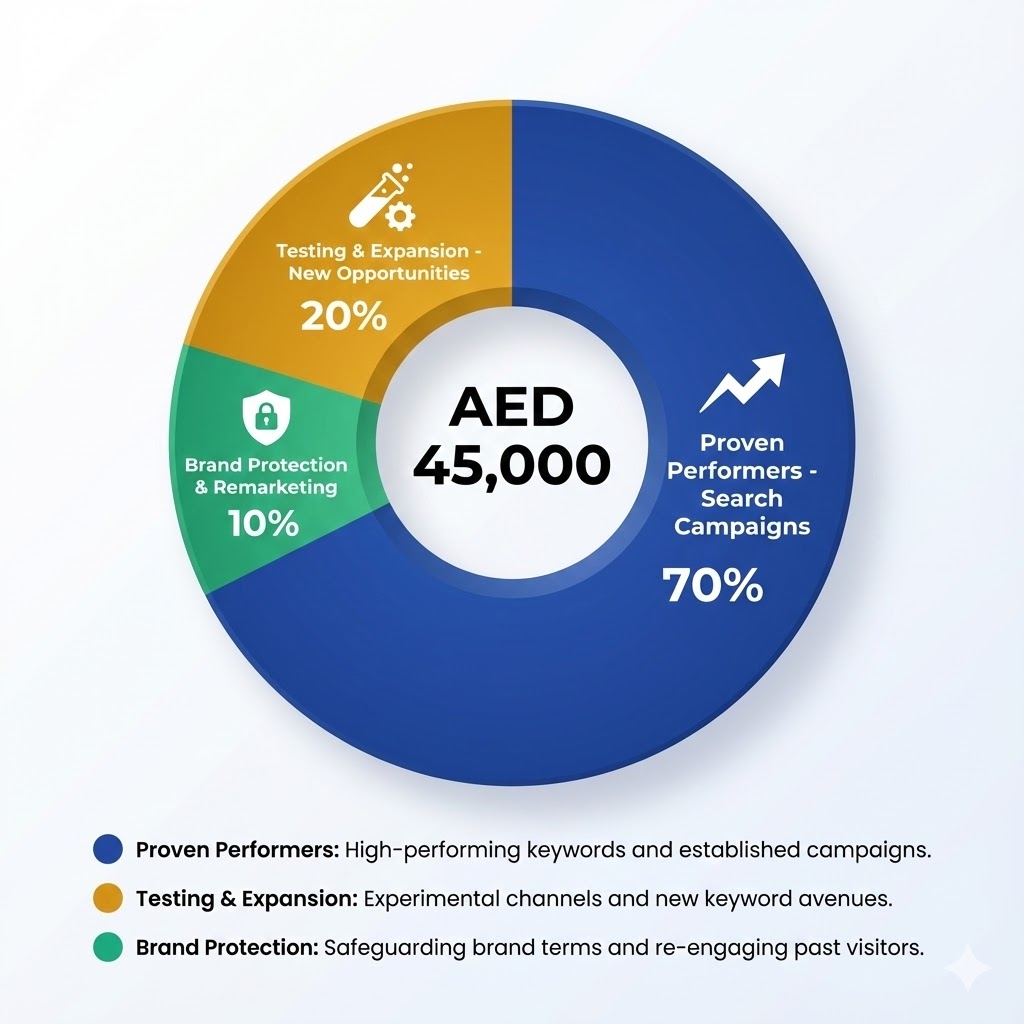
Most Dubai businesses distribute budget evenly across campaigns or simply let Google spend however it wants. Both approaches waste money.
I use a 70/20/10 framework that optimizes for ROI while maintaining growth:
70% to Proven Performers (Reliable Revenue)
- Search campaigns with consistent conversion history
- Keywords showing profitable CPA or ROAS over 3+ months
- My real estate client: 70% to specific development names (“Damac Islands Phase 2,” “Emaar Beachfront”)
- These convert at 4-6% with excellent ROI
- Continuously optimize through ad testing and Quality Score improvements
- Foundation is solid, deserves majority of budget
20% to Testing & Expansion (Future Winners)
- Performance Max campaigns discovering new audiences
- New keyword opportunities and emerging search trends
- Geographic expansions and audience testing
- Creative experiments and channel testing
- Enough budget to generate meaningful data (minimum 15-30 conversions)
- Example: Healthcare client discovered “DHA Prometric centers” reduced CPA by 35%
- Winners graduate to proven performer status after 4-6 weeks
10% to Brand Protection & Competitor Capture (Efficient Defense)
- Branded search campaigns (Quality Score 9-10, CPC under AED 2)
- Competitor keyword campaigns capturing alternative searches
- Remarketing campaigns (40-60% lower CPC, 3-5x conversion rates)
- Enormous volume at minimal cost
- Prevents competitors from stealing your visibility
Monthly rebalancing keeps this framework effective. Testing campaigns showing consistent profitable performance for 4-6 weeks graduate to proven status. Proven performers dropping below breakeven for 2+ weeks move to testing for diagnosis.
This framework prevented panic during Dubai real estate’s seasonal fluctuations. Property search volume drops 30-40% during Ramadan and summer months. Rather than cutting all budgets evenly, I shifted more allocation to proven performers that maintained efficiency and reduced testing budget temporarily.
The traffic growth from 50 to 44,800 monthly visits came from integrated SEO and paid strategy—70% of the paid budget supported high-intent keywords that converted immediately, 20% tested audience expansion and new channels, and 10% protected our brand and captured competitor spillover.
Search vs Display vs Performance Max: Budget Split Strategy
Campaign type matters more than most Dubai businesses realize. Search, Display, and Performance Max serve different purposes and require different budget treatments.
Search campaigns target high-intent users actively searching for your solution. These get 60-70% of total Google Ads budget for most service businesses. CPCs are higher in Search—my Dubai clients average AED 8-15 per click—but conversion rates are 3-8x better than other campaign types.
Healthcare and B2B services should allocate even more to Search because these buyers conduct extensive research before converting. My healthcare client puts 75% of budget into Search campaigns because medical professionals specifically search for “DHA licensing assistance Dubai” when ready to engage services.
Display campaigns build awareness and support remarketing. I allocate 10-20% of budget to Display, focusing almost entirely on remarketing to website visitors. Cold Display traffic converts at under 1% for most service businesses, but remarketing Display runs at 2-4% conversion rates with CPCs around AED 2-4.
Display works better for brand awareness campaigns with longer sales cycles. Dubai real estate developments launching new phases use Display to reach potential buyers who haven’t started searching actively yet.
Performance Max campaigns get 15-25% of budget during testing phases. Real testing data across 247 accounts shows Performance Max delivers better results than Search 58% of the time, particularly for e-commerce and visual products.
My approach combines Search and Performance Max strategically. Search campaigns protect high-value keywords with proven messaging and landing pages. Performance Max discovers new audiences and placements across Google’s ecosystem—YouTube, Discover, Gmail, Display.
For e-commerce clients selling products, Performance Max gets 30-40% of budget because it excels at product discovery and Shopping ads. For service businesses like my healthcare and real estate clients, Search dominates at 70-75% because intent matters more than discovery.
Budget shifts based on performance data. If Performance Max consistently delivers at or below target CPA for 8+ weeks, I increase allocation to 30-35%. If it underperforms for 4+ weeks, I scale back to 10-15% and diagnose issues.
The key is treating campaign types as complementary, not competitive. Search captures demand, Display builds it, and Performance Max discovers unexpected opportunities. The right budget split depends on your business model, sales cycle, and conversion data.
Ad Copy Testing: Why Your Ads Get Ignored (And How to Fix It)
The AIDA Framework for Dubai Google Ads
Dubai’s competitive market requires ad copy that immediately captures attention and drives action. I use the AIDA framework—Attention, Interest, Desire, Action—to structure every ad.
Attention (Make Them Stop Scrolling)
- Use Dubai-specific hooks that show local expertise
- ❌ Generic: “Best Healthcare Services”
- ✅ Specific: “DHA-Licensed Medical Recruitment—490+ Professionals Placed in 2024”
- For real estate: “Damac Islands—Waterfront Living from AED 1.2M” beats “Luxury Dubai Property”
- Numbers amplify attention: “40% Lower Property Management Fees”
- Development names create immediate relevance for searchers
Interest (Match Dubai User Intent)
- Answer “What makes this specifically valuable in Dubai right now?”
- Healthcare: “Full DHA License Support—Application to Dataflow Certification”
- Real estate: “8% Guaranteed ROI—Full Property Management Included”
- ❌ Generic benefits don’t work
- ✅ Specific, locally relevant benefits do
Desire (Build Credibility & Urgency)
- Social proof: “Join 490+ Healthcare Professionals We’ve Placed in GCC Hospitals”
- Scarcity: “Only 3 Beachfront Units Remaining”
- Authority: “Official RERA-Registered Developer”
- Dubai market responds strongly to licensing and registration signals
- DHA, RERA, years of operation, client numbers all build trust
Action (Clear CTA with Local Trust)
- Include Dubai phone number (+971) to prove local presence
- ✅ “Get Free DHA License Assessment—Call +971 50 XXX XXXX”
- ❌ “Learn More” (too generic)
- WhatsApp CTAs work well in GCC market
- Landing page must mirror ad promise exactly
Landing page alignment completes AIDA. If your ad promises “Free DHA License Consultation,” the landing page headline should mirror this exactly. Message mismatch kills conversions and tanks Quality Scores.
Responsive Search Ads: The 15-Headline Strategy
Responsive Search Ads let Google test combinations of up to 15 headlines and 4 descriptions to find top performers. Most Dubai businesses upload 3-5 headlines and call it done—they’re missing 70% of the optimization potential.
I create exactly 15 headlines for every important ad, structured strategically:
Headlines 1-3 focus on primary keywords for relevance. “DHA Medical License Dubai,” “GCC Healthcare Licensing,” “Dubai Medical Recruitment.” These ensure Ad Relevance scores stay high.
Headlines 4-6 emphasize specific benefits. “Full License Support—Application to Approval,” “490+ Healthcare Professionals Placed,” “Average 45-Day License Processing.”
Headlines 7-9 build credibility and trust. “6+ Years Dubai Experience,” “DHA-Authorized Service Provider,” “AED 0 Upfront Fees.”
Headlines 10-12 address objections and create urgency. “No Hidden Costs,” “Start Working in 60 Days,” “Limited October Openings.”
Headlines 13-15 test alternative angles. “Tired of Failed Applications?” “Skip the Complexity,” “We Handle Everything.”
The pinning strategy matters. I pin Headline 1 to Position 1 for brand consistency—every ad variation shows our primary keyword headline first. Everything else remains unpinned so Google can test combinations.
Descriptions follow similar logic. Description 1 expands on the headline promise with specific details. Description 2 includes a strong CTA with contact information. Descriptions 3-4 test alternative approaches.
Google needs minimum 100 impressions per asset to evaluate performance. Research on Responsive Search Ads confirms this threshold. Low-volume campaigns won’t generate enough data for meaningful optimization—stick to Expanded Text Ads (if still available) or use fewer headlines.
For my healthcare client’s DHA licensing campaign, the top-performing headline combination after 8 weeks was: “DHA Medical License Dubai” (Position 1, pinned), “490+ Healthcare Professionals Placed” (Position 2), and “Average 45-Day Processing” (Position 3). This combination delivered 6.2% CTR versus 4.1% account average.
Including Arabic headlines in English-primary campaigns doesn’t work—it confuses messaging and reduces relevance. Create separate Arabic campaigns with properly translated headlines if targeting Arabic-speaking audiences.
The Integrated Approach: Why I Replace 5 Dubai Agencies
The Full-Stack Advantage in Dubai’s Market
Most Dubai businesses coordinate separate vendors for SEO, Google Ads, content, web design, and conversion optimization. They pay AED 30,000+ monthly across five different agencies who rarely communicate and never align strategy.
This fragmented approach wastes 15-25% of budget through coordination problems:
The SEO agency optimizes for keywords the Google Ads team doesn’t bid on. The content writer creates blog posts that don’t support paid landing pages. The web designer builds beautiful pages with 4-second load times that tank Quality Scores. The Google Ads manager blames “bad traffic” without realizing landing page speed is the problem.
I replace this entire fragmented system with one integrated approach at 60% lower total cost. When the same person handles technical SEO, Google Ads optimization, and landing page design, everything works together.
Here’s how integration created my real estate client’s results—traffic growth from 50 to 44,800 monthly visits in 6 months:
Technical SEO improvements directly improved Quality Scores. I optimized Core Web Vitals, achieving LCP under 2.0 seconds and CLS under 0.1. These same improvements boosted Landing Page Experience scores in Google Ads from Average to Above Average, reducing CPCs by 28%.
Keyword research informed both organic and paid strategy. Instead of separate keyword lists, I identified high-intent terms worth bidding on (competitive, immediate intent) and long-tail terms worth targeting organically (lower competition, research intent). The blog content we created for SEO rankings also served as retargeting landing pages for Display campaigns.
Landing page conversion optimization benefited both channels. Form optimization that increased organic conversion rates from 2.1% to 3.8% also improved paid traffic conversion rates from 3.2% to 5.1%. One improvement, double benefit.
Content strategy aligned with paid seasonal trends. When Google Ads data showed 40% search volume increase for “Damac Island investment” after a development announcement, I immediately created supporting blog content. That content ranked organically within 3 weeks, reducing our need to bid aggressively on expensive paid terms.
The real estate case illustrates perfect integration—organic content captured top-of-funnel awareness searches, paid campaigns converted high-intent buyers actively searching for specific developments, and conversion-optimized landing pages maximized results from both channels.
My healthcare client’s 180% lead increase came from the same integrated thinking. I identified that “DHA Prometric exam dates” had high organic search volume but low paid competition. Created ranking content for that term, which naturally funneled traffic to our paid landing pages for DHA licensing services. One content piece generated 340 organic leads and influenced 120+ paid conversions through assisted attribution.
Coordination overhead disappears completely. No weekly status calls between five different agencies. No finger-pointing when results underperform. No misaligned strategies where SEO and paid compete instead of complement.
The cost difference is substantial. Five separate agencies in Dubai typically charge: SEO (AED 8,000-12,000 monthly), Google Ads management (AED 5,000-8,000 monthly), Content creation (AED 4,000-6,000 monthly), Web design/development (AED 6,000-10,000 monthly), and CRO/optimization (AED 3,000-5,000 monthly). Total: AED 26,000-41,000 monthly before any advertising spend.
My integrated approach delivers all five disciplines at AED 12,000-18,000 monthly—40-60% lower cost with better results because everything works together from day one.
Google Ads Dubai: Your Questions Answered
What is Google Ads and why does it matter for Dubai businesses?
Google Ads is an auction-based advertising platform where businesses bid to show text, display, and video ads when users search for relevant keywords or browse Google’s network. Unlike traditional advertising, you only pay when someone clicks your ad.
Dubai businesses need Google Ads because the UAE has 99% internet penetration and users conduct extensive online research before purchasing. When someone searches “DHA medical license Dubai” or “Damac Islands investment,” your ad can appear instantly at the top of search results—ahead of organic listings that take months to rank.
The measurable ROI makes Google Ads essential. Industry data shows an average 800% return—AED 8 in revenue for every AED 1 spent on advertising. For Dubai service businesses with high customer lifetime values, this ROI can exceed 1000%. Healthcare recruitment, real estate, legal services, and B2B consulting all benefit from immediate lead generation that Google Ads provides.
The targeting precision matters in Dubai’s diverse market. You can target specific Emirates, languages, devices, and even times of day when your ideal customers search. This eliminates the waste inherent in traditional advertising where 60-80% of impressions reach the wrong audience.
How much does Google Ads typically cost in Dubai?
Google Ads costs in Dubai vary dramatically by industry due to competition levels and customer values. Dubai market research shows these CPC ranges as of 2025:
Healthcare and medical services cost AED 15-30 per click for competitive terms like “medical license Dubai” or “healthcare recruitment.” Real estate averages AED 5-20 per click depending on specificity—generic “Dubai property” costs more than specific development names. B2B services like accounting or consulting run AED 6-15 per click. E-commerce and retail sit lower at AED 3-12 per click due to less competition.
Monthly budgets depend on business size and goals. Small businesses typically spend AED 5,000-25,000 monthly. Medium businesses allocate AED 25,000-75,000 monthly. Large enterprises commonly exceed AED 75,000 monthly across multiple campaigns.
The UAE market runs 8% more expensive than US advertising according to comparative industry analysis. Dubai’s international business environment and high purchasing power drive this premium.
Total costs include both click charges and management. If you hire an agency, add AED 3,000-10,000 monthly management fees. I include comprehensive management in my integrated approach at significantly lower total cost than traditional agency models.
What are the main benefits of Google Ads for UAE companies?
Google Ads provides five critical advantages for UAE businesses competing in Dubai’s market:
Immediate visibility places your business at the top of search results within hours. Unlike SEO that requires 3-6 months to generate rankings, Google Ads traffic begins the day you launch campaigns. This matters for new businesses establishing presence and seasonal businesses capitalizing on peak demand periods.
Precise targeting reaches your exact customer. Target by location (specific Emirates or neighborhoods), language (English, Arabic, Hindi), device (mobile vs desktop), time (business hours only), and even income level. My real estate clients target high-income users exclusively, eliminating clicks from people who can’t afford AED 1.5M+ properties.
Measurable ROI shows exactly which keywords, ads, and campaigns generate revenue. Every dirham spent is tracked to specific business outcomes. This accountability doesn’t exist in traditional advertising where measuring billboard or radio effectiveness remains guesswork.
Scalability allows you to increase budgets when campaigns prove profitable and decrease when they underperform. During Dubai real estate’s peak season (October-December), I increase budgets 40-60% to capture elevated demand. During summer slowdowns, we reduce spending accordingly.
Competitive advantage captures customers actively shopping your competitors. Someone searching “alternative to [competitor name]” or comparing providers represents a high-intent buyer ready to switch. Strategic competitor keyword targeting steals market share at the moment of decision.
The combination of these benefits explains why 41% of UAE digital marketing budgets now flow to Search advertising.
How long does it take to see results from Google Ads?
Google Ads delivers results in three phases, each with different timelines and expectations:
Immediate traffic begins within 24-48 hours of campaign launch. Once Google approves your ads (typically within 1 business day), they start showing for your targeted keywords. You’ll see clicks and impressions immediately. My healthcare client generated their first 3 leads within 6 hours of launching DHA licensing campaigns.
Optimization and efficiency improvements require 2-4 weeks. Google’s Smart Bidding algorithms need this learning period to understand which users convert. Quality Scores take 2-3 weeks to stabilize as Google evaluates your CTR, ad relevance, and landing page experience. During this initial phase, expect CPAs 20-40% higher than they’ll eventually become.
I don’t make major changes during the first 2 weeks—the algorithms need time to learn. Impatient account changes reset this learning period and delay profitable performance.
Mature campaign performance develops over 3-6 months. This is when campaigns hit optimal efficiency with fully optimized Quality Scores, refined negative keyword lists, tested ad copy, and historical performance data powering accurate bid strategies. My real estate client’s campaigns peaked at 6 months with 40% cost reduction and 180% volume increase compared to launch.
Long sales cycle businesses require longer timelines. Dubai real estate has 3-6 month consideration periods—someone clicking your ad in January might not purchase until April. Healthcare recruitment often takes 2-4 months from initial contact to placement completion.
Set realistic expectations: immediate traffic, profitable performance in 1-2 months, and optimal results in 3-6 months with consistent optimization.
What are common mistakes Dubai businesses make with Google Ads?
After auditing 40+ Dubai Google Ads accounts, these five mistakes appear consistently and waste the most budget:
1. Ignoring Quality Score Optimization (36% Cost Premium)
Most businesses never look at their Quality Scores and don’t understand how Expected CTR, Ad Relevance, and Landing Page Experience directly impact their costs. Research shows improving from Average to Above Average Quality Scores reduces CPC by approximately this amount. One audit revealed a Dubai healthcare client with Quality Score 4 on their best keywords—they were paying double what they should.
2. Incomplete Conversion Tracking (Blind Optimization)
I’ve audited accounts spending AED 30,000+ monthly without tracking phone calls, WhatsApp inquiries, or offline conversions. They only tracked online forms representing 25% of actual leads. Without complete tracking, you’re optimizing for the wrong goals and can’t measure true ROI. One real estate client thought their campaigns weren’t working until we tracked showroom visits—suddenly they had 180 conversions monthly instead of 45.
3. Wrong Bid Strategy Selection (Algorithm Mismatch)
New campaigns with 8 conversions monthly using Target CPA fail because the algorithm lacks data. Campaigns using Maximize Conversions without CPA guardrails spend AED 1,000 daily regardless of conversion costs. One B2B client was using Target CPA of AED 50 when their profitable threshold was AED 180—Google couldn’t deliver at that price, so the campaign barely spent budget.
4. Broad Match Without Negative Keywords (35% Waste)
Industry research shows broad match generates 35% irrelevant traffic without proper negative lists. Dubai healthcare campaigns trigger for “nursing jobs Dubai” when targeting medical licensing. Real estate campaigns show for rental searches when selling properties. Building comprehensive negative keyword lists recovers 20-30% of wasted spend within the first month.
5. Poor Landing Page Experience (Quality Score Killer)
Sending all traffic to your homepage instead of relevant dedicated pages reduces conversion rates 60-80%. Landing pages loading slower than 3 seconds get flagged as Below Average, increasing CPCs dramatically. One Dubai property developer sent all clicks to their homepage—after creating development-specific landing pages with sub-2-second load times, Quality Scores jumped from 5 to 8 and CPC dropped 34%.
The combination of these mistakes explains why most Dubai businesses waste 60%+ of their Google Ads budget. All five are fixable within 2-4 weeks of focused optimization.
Stop Wasting AED 20,000 Monthly on Fixable Mistakes
Dubai’s competitive Google Ads market rewards businesses that understand Quality Score optimization, proper campaign structure, and strategic bid management. Most waste 60%+ of their budget through low Quality Scores, wrong bid strategies, and poor conversion tracking.
I’ve proven this framework works across Dubai healthcare and real estate clients. My healthcare client reduced cost-per-application by 45% while generating 180% more qualified leads. My real estate client grew traffic from 50 to 44,800 monthly visits through integrated SEO and optimized paid campaigns. Both achieved 40-45% cost reductions while maintaining or increasing lead volume.
The difference between profitable Google Ads and wasted spend isn’t budget size—it’s optimization discipline. Businesses spending AED 15,000 monthly with proper Quality Score management outperform competitors wasting AED 40,000 on unoptimized campaigns.
The full-stack integrated approach eliminates the coordination waste inherent in managing five separate agencies. When one specialist handles your SEO, Google Ads, landing pages, content, and conversion optimization, everything works together at 60% lower cost than fragmented vendor relationships.
Your next step is simple: Get your free Google Ads audit at muhammadzubair.me. I’ll analyze your current campaigns and show you exactly where you’re wasting money and how to fix it. No generic recommendations—specific, actionable changes based on your account data.
Or call me directly at +971 50 136 1813. I’m based in Dubai with 6+ years managing GCC campaigns, and I’m currently helping Haus & Estates Properties and First Medical Consultancy dominate their markets through optimized Google Ads.
The question isn’t whether Google Ads works—it’s whether you’re willing to stop wasting AED 20,000+ monthly on mistakes you can fix starting today.